
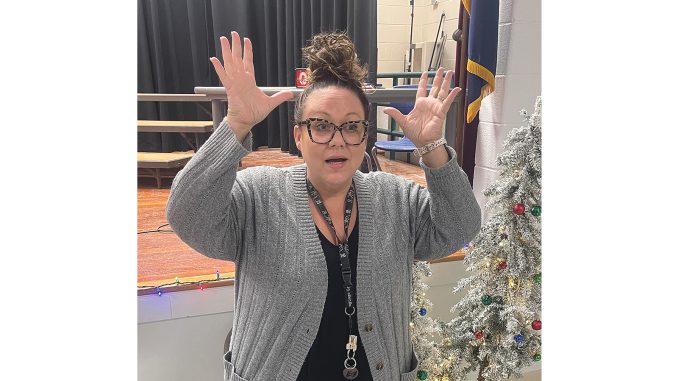
Angela Teasley never planned to become an interpreter for American Sign Language (ASL). Through church camps in her youth she learned to sign the alphabet, but that was it.
As a young adult, she loved to dance, visiting local area clubs and almost every visit, she saw the same two men who appeared to be signing to each other. Teasley never thought they were actually deaf.
“I would see these two guys writing on bar napkins and I thought that was just their way of meeting girls,” she jokes. “Eventually one of them asked me to dance. I saw his hearing aid, but I didn’t think he could actually be deaf, because he could dance.” At the end of the evening, both gentleman walked Teasley to her car. Outside when the world was quiet and still, she realized they were deaf.
Over the next few years, Teasley befriended the two men. To communicate, she began learning signs. Filling spiral notebooks, Teasley would write a word and her friends would teach her how to sign it. She wrote less and signed more. Teasley would go months without using her voice, signing to communicate — being totally immersed in the deaf community.
With curiosity, Teasley enrolled in ASL classes at Tidewater Community College, still with no intention to become an interpreter. While she worked as a server and bartender, she’d practice by signing drink orders and menu items during her shift. However, Teasley was too advanced for entry level courses, and her professor suggested she not only look into the next advanced course but also take the Virginia Quality Assurances Screening test to see how advanced she was.
The result? She received a Level II/I. “And that’s when I began interpreting,” she says.
No formal training, just a life of immersion into a new community. Teasley began working for Suffolk Public Schools, interpreting for 10th grade high school students.
“I had no clue what I was doing — I learned as I went,” Teasley says.
Interpreting wasn’t just part of her life at this point, it became part of her. She began working and maintaining a level III/III at the state level, bouncing among school systems. In 2010, she began working for Hampton City Schools, where she stayed the next five years, as a lead educational interpreter for the district.
“I loved it. It was my life,” she says.
A full-time position opened, working as a medical interpreter for The Language Group (TLG). Teasley was apprehensive but applied and interviewed. “I was terrified to leave the only professional job I had ever known, in education. I was good at it, I was a leader, respected. I was safe,” Teasley says.
It wasn’t just leaving the job security that concerned her; it was the anxiety of returning to the community on a more personal level. She went from having the deaf community in her personal life and shifted to it being her profession.
“I was worried how my deaf friends would feel with me coming back into their lives to interpret for them. Would they trust me? Would they want me? Would they feel comfortable with me?” she questioned. After 25 years away, she was anxious about the level in which she’d be welcomed back to the deaf community now as a medical interpreter.
Despite the worries and fears, she took a leap of faith and accepted the offered position by The Language Group, located in Virginia Beach, an award-winning language solutions company providing translation, interpreting and localization services to clients worldwide. Confident in her capabilities, Teasley was ready.
Medical interpreting is extremely different from educational interpreting. It’s personal, private, intimate, complex and always changing. It’s providing people with access to care. “Access is critical, especially when it comes to you or your loved ones,” she says. “The Language Group does everything to ensure our consumers get the language access they need.”
Teasley says the decision to transition into the medical world was the best decision she ever made. “It’s easy to look at people who are deaf and see them as handicapped, but truly they really aren’t in many ways, and they don’t feel that way. It’s just a language barrier,” she says.
As a medical interpreter, Teasley bridges the gap in this language barrier. She provides depth between patients and doctors, making direct and immediate impacts every time she steps through the door.
“Now at 46 years old, after meeting hearing-impaired people when I was 19, I get to return to the community that gave me the gift of language,” Teasley says. “I wake up every day to serve those who blessed me with the gift of their language and culture. They let me in, embraced me and taught me the deaf way. I am able to serve the community that gave me this gift.”
TO THE POINT:
Angela Teasley
Phone: 757-675-1263
Email: angelat@thelanguagegroup.com

