The largest estuary in the United States, covering 64,000 miles, the Chesapeake Bay was formed when rising sea levels flooded river valleys after the last ice age. Area rivers, creeks, bays and lakes form a vibrant and estuarine landscape for marine life. Many of the 1.7 million residents of Hampton Roads and surrounding Virginia Peninsula cities and counties, including 80,000 active-duty military members and their families, commute to work and home through area tunnels and bridges that span these waterways.
Hampton Roads boasts the largest concentration of fleet headquarters administrative and communication facilities outside the nation’s capital. The Hampton Roads Bridge-Tunnel (HRBT) is, additionally, the gateway to the Outer Banks and other areas south, and is used by travelers, holidaymakers and sightseers traveling both north and south.
Long before the HRBT was constructed, travel was limited to ferry passage via two routes, requiring approximately 30 minutes to complete the trip from Hampton to Norfolk. The more popular route began at Hampton Boulevard near Naval Station Norfolk, with an additional route from Willoughby Spit to Fort Monroe, and typically carried 2,500 vehicles per day. With a growing population and ever-increasing traffic, the new HRBT was proposed, built and then opened November 1, 1957, and began as a two-lane structure with a parallel bridge-tunnel completed in 1976. An engineering marvel when first constructed — and the world’s longest immersible tube tunnel at 7,479 feet — it was also the first tunnel built between two artificial islands, South Island connected to Norfolk, and North Island connected to Hampton.
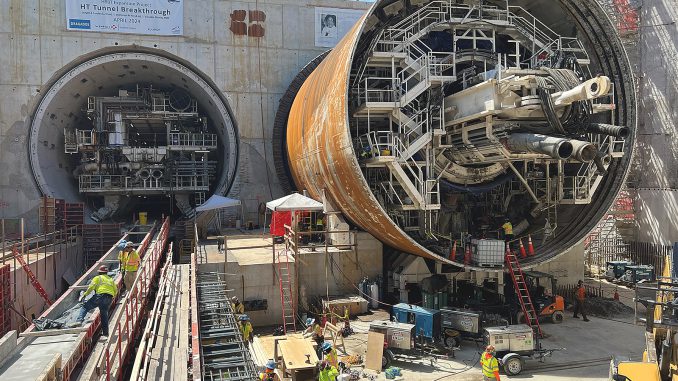
Today’s bridge expansion, owned by Virginia Department of Transportation (VDOT) and overseen by the Hampton Roads Transportation Accountability Commission, is even more forward-thinking with the HRBT being only the third tunnel in the country to be built with Mary, the tunnel boring machine (TBM) that has replaced the standard tunnel immersion process. Named after Mary Winston Jackson, who was educated at Hampton University and the first woman of color employed by NASA as an engineer, the TBM launched from South Island in April 2023 and was custom-built for excavation and placement of the tunnels.
The HRBT expansion project is expected to reduce congestion that sometimes can result in back-ups of six miles or more. More than 100,000 vehicles cross the HRBT at peak times during the summer at an average travel time of seven minutes, substantially less than the 30-minute ferry ride. And as Mary completed the first tunnel, hundreds of staff and workers cheered as she broke through the headwall. In a single day, Mary progressed 113 feet, the best production day of any roadway tunnel TBM in the country.
Ryan Banas, associate vice president and project director, is passionate about VDOT’s most expansive project in Virginia’s history and is hoping to inspire the next generation of engineers. A real-life laboratory for up-and-coming engineers, the project has welcomed students from Old Dominion University, who can explore the building process that will encompass 10 miles of roads and bridges. One such student began as an intern and is now a full-time field engineer on the project.
Banas also speaks excitedly about what will not impact Hampton Roads during the expansion. Marine monitors have been involved in the project to ensure protection of the aviary and marine life present in the area. A team of trained border collies, wearing protective gear to ensure their safety, were moved to South Island to encourage birds to nest elsewhere. Additionally, Banas speaks about eminent domain and right-of-way protections. The expansion project is incorporated within existing rights-of-way to minimize the impact on adjacent communities. “When this project is complete,” says Banas, “the existing two lanes we maintain in each direction now will continue to remain free of charge to use those existing lanes.”
What will impact Hampton Roads are the 10 miles of refurbished and rebuilt roadways and bridges and the eight lanes of new roadway and tunnel.
This building process, including scale models of the TBM, can be seen at the newly opened Welcome Center just off 4th View in Norfolk. Appointments are required to tour the center, allowing plenty of time to view the tools and devices used to build the tunnel, and the magnitude of the expansion. Visitors can also learn more about the Civil War era cannonballs and 10,000-year-old Mastodon bones uncovered while digging the new tunnel.
Hampton Roads Connector Partners, design-build prime contractors for the project, has given an expected final completion date of August 2027. “Our contractor is on track to meet that date,” Banas says. There is also a substantial completion date in February 2027 (the date the new tunnels can be used for travel) and an early incentive completion date of September 2026.
TO THE POINT:
HRBT Project Team
Phone: 757-578-9284
Email: HRBTinfo@VDOT.Virginia.gov
Website: www.HRBTExpansion.VDOT.Virginia.gov
Podcast: podcasts.apple.com/us/podcast/hrbt-tunnel-talk/id1485424828
Welcome Center Tour Information: HRBTinfo@VDOT.Virginia.gov