
Artificial intelligence (AI) is one of those things people aren’t quite sure how to handle. Is it something to fear or something to laud? While the answer may be a bit of both, there is no denying the benefit AI brings to educators, business professionals, attorneys and medicine, to name a few.
AI has been around longer than many understand, in the form of voice-activated menus, home systems that can turn lights off and on, editors like Grammarly to assist with writing and more. And, apart from maybe the frustration of not being able to speak to a human before advancing through a dozen questions, many would say life is improved because of the advent of artificial intelligence.
That certainly is the case in the medical industry, with advances like automated documentation, patient support, data management, medical imaging, diagnostic support and the inclusion of surgical robots that assist in multi-specialty surgeries. These surgical robots have been in existence since the 1980s and are now standard for procedures in specialties such as gynecology, urology and general surgery.
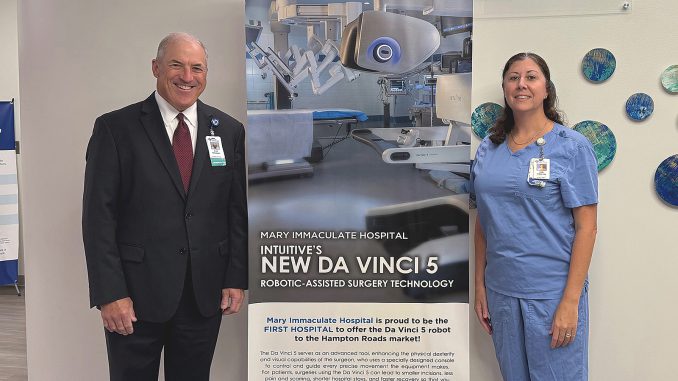
In fact, on January 20, 2025, Mary Immaculate Hospital was the first in Hampton Roads to rollout use of the third-generation surgical robot, Da Vinci 5 (DV5), having used its predecessors, Da Vinci Si and XI models.
The robot is equipped with four arms and a console where medical practitioners sit and control it. At this console, providers “can see inside an abdominal cavity — almost like goggles — with their hand on the controllers, moving the surgical instrument,” says Alan George, president of Bon Secours Mary Immaculate Hospital.
The DV5 replaces laparoscopic procedures, decreasing time in the operating room, thereby reducing the amount of time a patient must be under anesthesia. It also results in smaller incisions and quicker patient recovery. George says the greatest benefit is that the DV5 affords surgeons “finer motor movement, allowing them access to smaller areas to perform work that’s more difficult when done laparoscopically.”
As expected, patients must consent to robotic procedures and, since they don’t require as many incision sites, they reduce bruising to the body, and procedures take less time. Most people are excited to use the new technology.
Currently, there are eight surgeons using surgical robots at the hospital. While the DV5 is mostly used to assist in complex surgical cases (typically anything inter-abdominally), the software systems for integrated use of AI are quite beneficial for reading radiological results as well. It has the potential to flag certain records to assure the attending physician knows what’s going on. “AI is not, however, a substitute for the physician’s medical knowledge; it is a tool to help narrow down what the medical issue is,” says George.
Lori Morewitz, operating room director, concurs, saying, “Mary Immaculate prides itself on high quality care and we embrace technology for the betterment of our patients. I truly believe it is a really great place for patients, as we bring the newest and best technology to help care for them.”
While AI is changing the face of medicine and so much more, some things still happen the traditional way. As Morewitz mentions, “I have three teenagers, and you can usually find me on the soccer field. I also like to find time to read.” For George, those “traditional” passions include running marathons and golfing, and he emphasizes, “Obviously, the most important time is family time.”
When all is said and done, whether it’s artificial intelligence or just “hanging out,” it’s the human connection that makes the difference.
TO THE POINT:
Bon Secours Mary Immaculate Hospital
Address: 2 Bernadine Dr., Newport News, VA 23602
Contacts: Alan George, president; Lori Morewitz, operating room director
Phone: 757-886-6768
Website: bonsecours.com/locations/hospitals-medical-centers/hampton-roads/bon-secours-mary-immaculate-hospital

